
On the morning of June 10, 2026, a single 8-A filing slid onto the SEC’s servers and almost no one noticed. It is the dull, procedural form a company files days before it starts trading. For SpaceX, it was the last paperwork before the biggest stock-market debut in the history of capitalism.
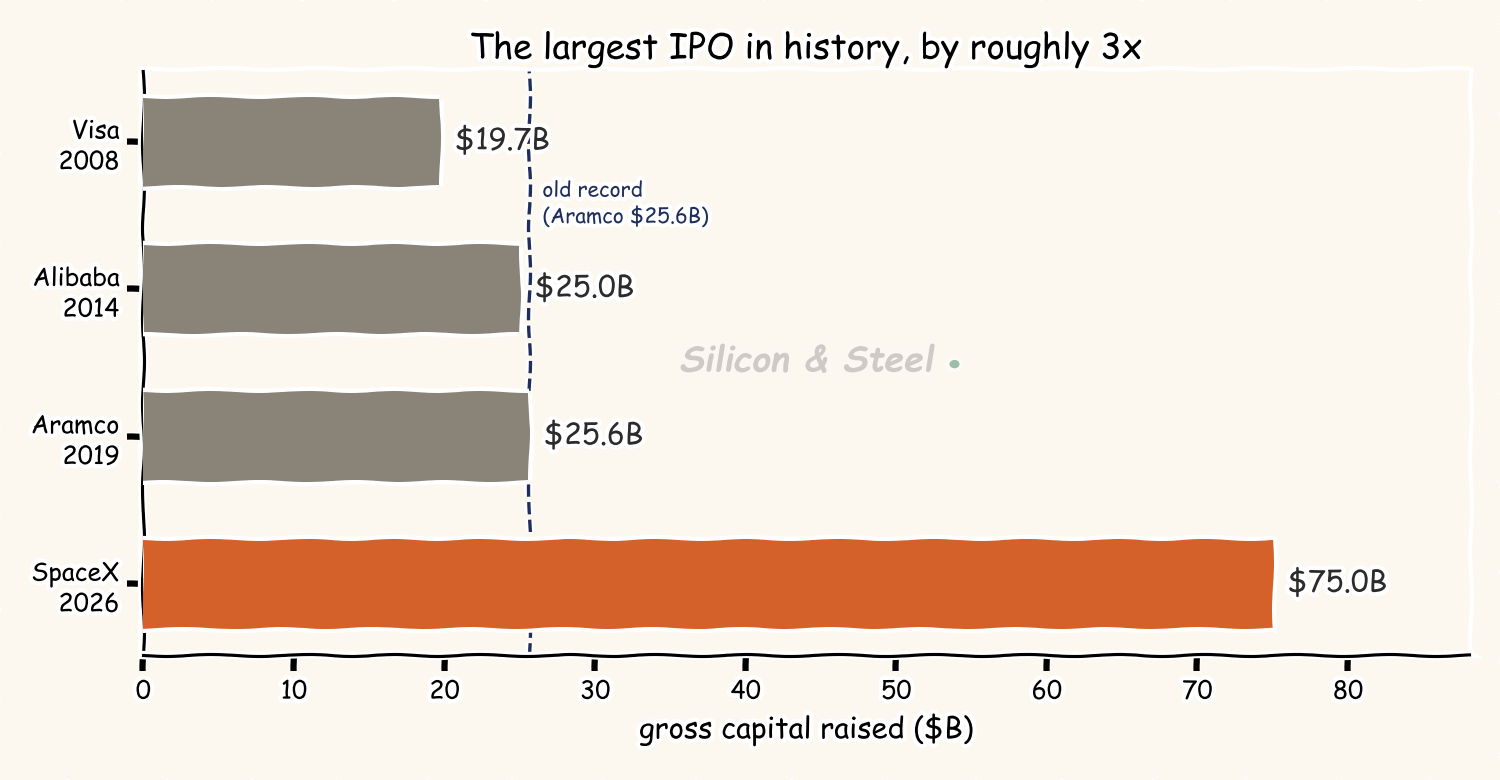
The number everyone will quote is the raise: roughly $75 billion, at $135 a share, listing on Nasdaq under SPCX. That is about three times the previous record, Saudi Aramco’s $25.6 billion in 2019. But the raise is the least interesting thing in the filing. Spend a few hours inside the four documents SpaceX submitted, a confidential draft in March, the public S-1 in May, then two amendments in early June, and a quieter story emerges. The company going public is not the rocket company you remember. It is becoming something stranger, and far more ambitious.
SpaceX did this deliberately, and in stages. Reading them in sequence is the closest thing we have to watching the company decide how much to reveal.
Put together, they describe an offering of 555,555,555 Class A shares at $135, a number chosen, almost cheekily, to multiply out to exactly $75 billion. Net of fees, SpaceX keeps about $74.4 billion (up to $85.7 billion if bankers exercise their over-allotment). For scale:
At $135 a share across roughly 12.5 billion Class A and Class B shares, SpaceX comes public worth about $1.7 trillion, call it $1.75 trillion fully diluted. That alone would make it one of the ten most valuable companies on Earth on day one, above Berkshire Hathaway, above almost every bank.
Two structural details matter more than the headline figure. First, control is absolute: assuming the offering as described, Elon Musk holds about 82.4% of the voting power through high-vote Class B stock, while the Class A shares the public is buying carry just 11.5% of the vote combined. You are buying the economics, not the steering wheel. Second, the filing discloses a Tesla-style incentive: a CEO award that vests across twelve valuation milestones, from $1.065 trillion to $6.565 trillion, in $500 billion steps. That top rung is not a forecast, it is management’s stated ambition, written into the legal record. It tells you how big the people running this company think it can get.
Here is where the cheerleading and the doom-mongering both fall apart. The top line is genuinely excellent. Revenue climbed from $10.4 billion in 2023 to $14.0 billion in 2024 to $18.7 billion in 2025, roughly 34% compounding, at a scale where that pace is rare. The first quarter of 2026 brought in $4.7 billion, up from $4.1 billion a year earlier.
And yet the company lost money: a $4.9 billion net loss in 2025, and $4.3 billion in the first quarter of 2026 alone. A bear stops reading there. But look at why. Research and development in Q1 2026 jumped about 126% year over year. This is not a business failing to make money; it is a business choosing to spend its launch-and-Starlink profits on two of the most expensive moonshots in technology, Starship and a vast new AI effort, faster than they can flow to the bottom line.
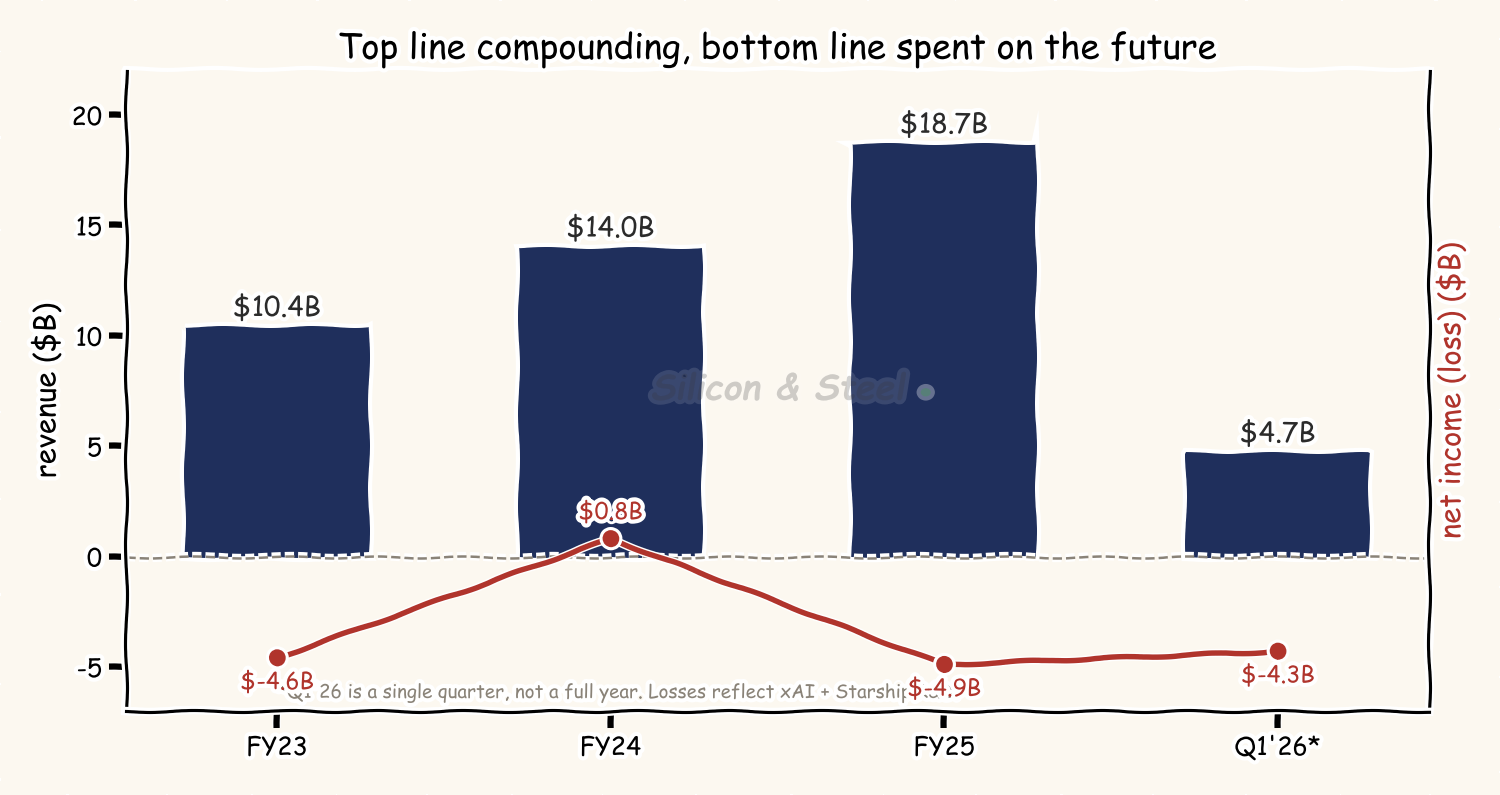
The distinction that separates a measured optimist from a cheerleader is this: the losses are real, but they are investment, not decay. The test is whether the spending compounds into the next monopoly or simply evaporates. The rest of this piece is about reading that test.
The single most under-reported fact in the prospectus is buried in the accounting. SpaceX’s financials have been “retrospectively recast” to fold in two companies most people did not realize it owned. In February 2026, SpaceX absorbed xAI, Elon Musk’s AI lab, maker of the Grok models. xAI had itself absorbed X (the former Twitter) the year before. The rocket company now also owns a frontier AI lab and a global social platform.
Suddenly the strategy snaps into focus. SpaceX tells investors it will spend the IPO proceeds on, in its own words, “the expansion of our AI compute infrastructure,” alongside launch and satellites. The losses make sense: training frontier models is brutally capital-hungry. And the largest IPO in history turns out to be, in large part, a way to fund American AI at a scale that even the hyperscalers would find eye-watering. The rocket is the foundation. The building going up on top of it is artificial intelligence.
The reason this is a measured-optimist story and not a fairy tale is that, unlike most companies with trillion-dollar ambitions, SpaceX has a working machine underneath. Each business pays for the next one.
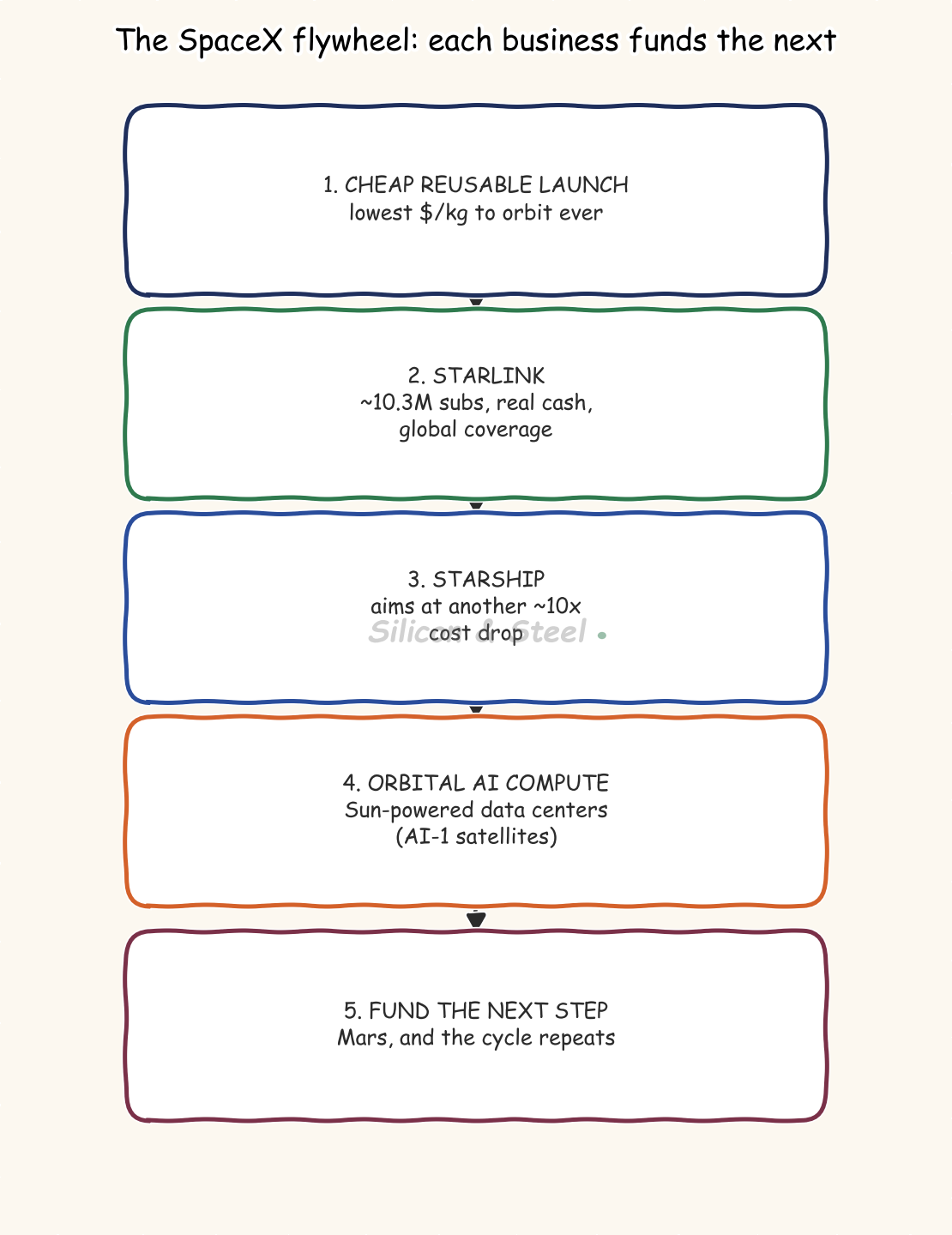
Reusable launch made space cheap, which made Starlink possible. Starlink, now 10.3 million subscribers across 164 markets, throws off real cash and a global network. Starship, when it works, aims to cut the cost to orbit by another order of magnitude. And cheap mass to orbit is precisely what makes the next idea, putting data centers in space, go from science fiction to a line item. SpaceX’s CFO, Bret Johnsen, put it plainly in a pre-IPO interview: launch “is the enablement for all of the other businesses, whether it’s Starlink, direct-to-cell very soon, or now AI compute.”
This is the part that sounds the most absurd and is, on inspection, the most rational. The prospectus leans on a hard fact about the United States: electricity generation has been nearly flat for fifteen years, growing about 0.1% a year from 2008 to 2023, even as AI demand explodes. America cannot build power plants fast enough to feed the data centers it wants.
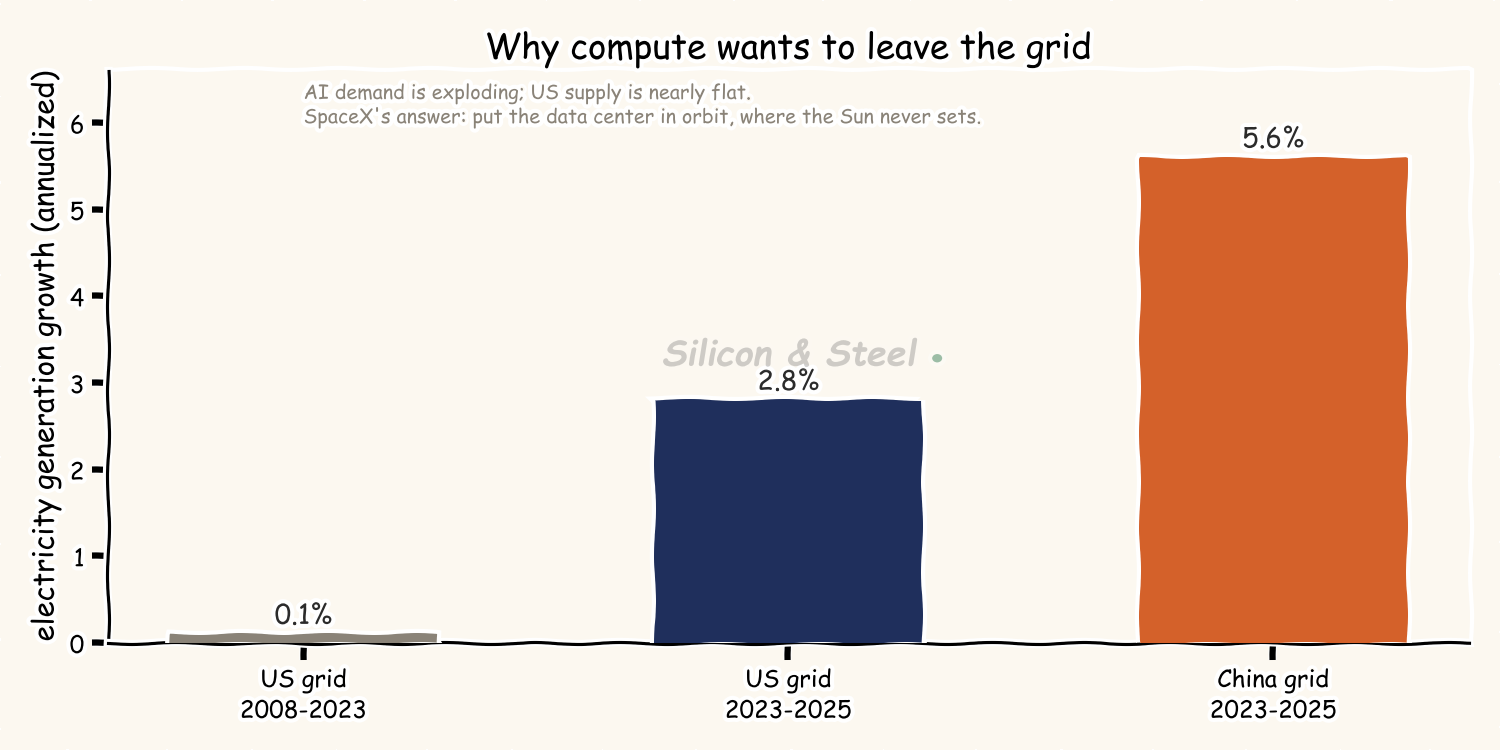
Start with the bottleneck, because it is the whole argument. For a decade the constraint on computing was the chip; today, increasingly, it is the electron. A single modern AI training cluster can draw as much power as a small city, and the queue to connect a new data center to the US grid now runs for years. China, meanwhile, has been adding generation at roughly twice the American pace. You cannot win an AI race you cannot power, and the prospectus is unusually blunt that this, not silicon, is the binding limit.
SpaceX’s answer, unveiled by Musk in a video posted to X on June 8, is to put the compute where the power is unlimited and free: orbit. In the right orbit the Sun never sets, so a solar panel runs around the clock with no battery, no fuel, and no grid connection to wait for. The first design, the AI-1 satellite, carries roughly the compute of a single Nvidia GB300 rack, about 150 kilowatts, wrapped in a 70-meter wingspan of solar panels and a deployable liquid radiator to shed heat into the vacuum, the one genuinely hard engineering problem when there is no air to cool you. SpaceX is building an 11-million-square-foot “Gigasat” factory in Bastrop, Texas to mass-produce them, targeting 1 gigawatt of orbital AI compute by the end of 2027 and roughly ten times that each year after.
Here is the measured version. The logic is sound, sun-powered compute, no grid queue, launched by the cheapest rockets in the world, and it is the kind of idea that only looks reasonable because launch got cheap first. But the open questions are real and worth naming: radiating waste heat in vacuum at gigawatt scale has never been done; high-bandwidth links between orbit and ground are non-trivial; radiation degrades electronics; and you cannot send a technician to swap a failed rack. The timeline, 1 GW in roughly eighteen months, is the most aggressive claim in the entire filing. I would bet on the direction and discount the schedule. That is usually the right way to bet on this company.
If today’s losses make you nervous, history offers an unsettling kind of comfort. In 2008, SpaceX was not a $1.7 trillion colossus; it was a startup that had failed three launches in a row. Falcon 1’s first flight, in 2006, lost an engine seconds after liftoff. The second, in 2007, made it to space but tumbled before reaching orbit. The third, in August 2008, was destroyed when a freshly upgraded stage collided with itself during separation, and went down carrying NASA and Air Force payloads with it. Three rockets, three failures, and a company running on fumes.
Musk has since described that autumn as the worst of his life. He was simultaneously trying to keep Tesla alive through the financial crisis, had poured his PayPal fortune into both, and by his own account was down to roughly enough cash for a single additional launch attempt, if the fourth flight failed, “that would have been it.” On September 28, 2008, the fourth Falcon 1 reached orbit, the first privately built liquid-fueled rocket ever to do so. Weeks later, NASA awarded SpaceX a $1.6 billion cargo contract to resupply the Space Station. The company that almost died in September was, by Christmas, funded for a decade. Everything, Falcon 9, Dragon, reusability, Starlink, flows from that single contract landing when it did.
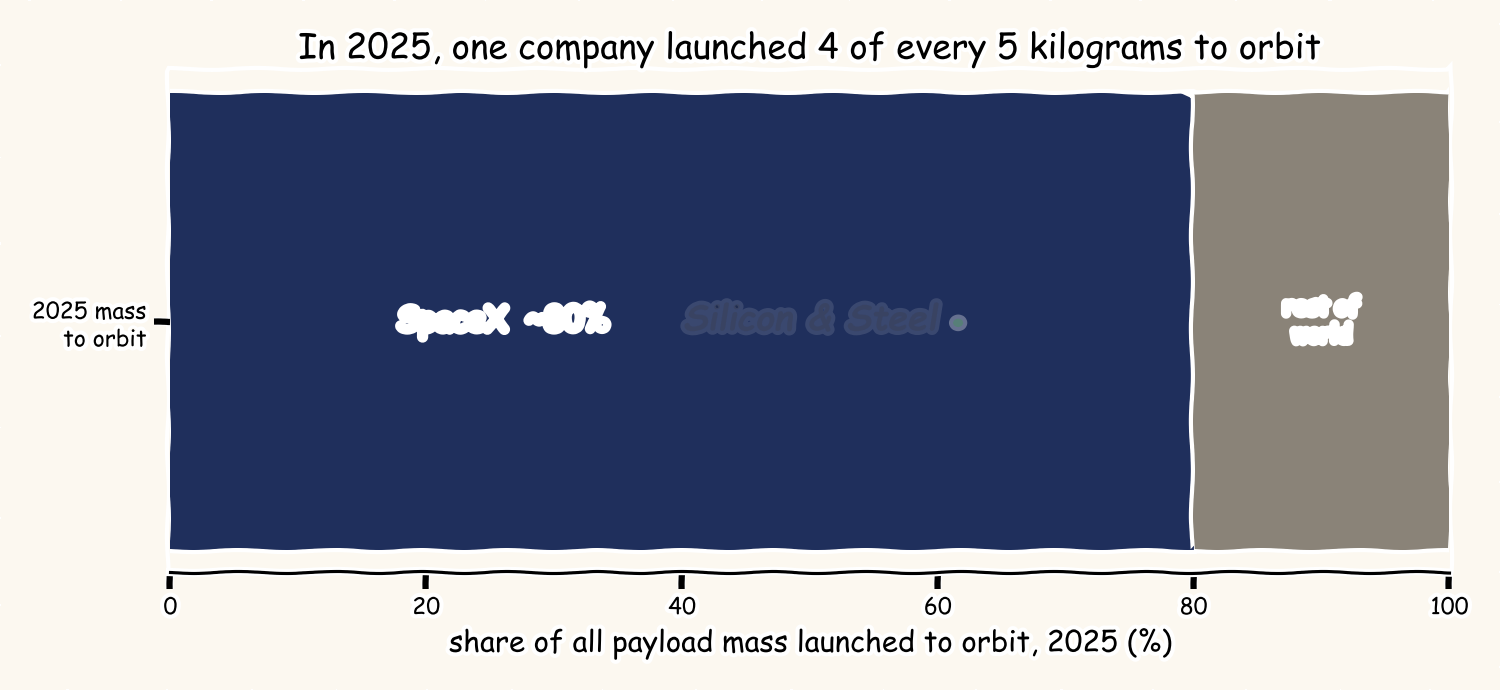
Strip away the valuation debate and one fact remains genuinely strategic: in 2025, SpaceX launched more than 2,200 metric tons to orbit, over 80% of all the mass humanity put into space that year. Not 80% of American mass. Eighty percent of the world’s.
It is the primary launch provider for the US government: in 2025 it flew 11 of 12 national-security launches and all five of NASA’s crew and cargo missions to the Space Station. It is, today, the only American operator that can carry astronauts to orbit. That is not a stock-market fact; it is a national-capability fact, and it is a large part of why this IPO matters beyond finance. A country’s access to space, its frontier internet, and now a chunk of its AI ambition are concentrating inside one publicly traded company.
For readers of this newsletter, the most important consequence of this IPO is not financial, it is industrial. If SpaceX is serious about gigawatts of orbital compute, it becomes, almost overnight, one of the largest new buyers of leading-edge silicon, advanced packaging, high-efficiency solar, and exotic thermal hardware on the planet. A GB300-class rack per satellite, multiplied toward a 1 GW target, implies a chip order book that competes for the same TSMC capacity, the same CoWoS packaging lines, and the same HBM supply that every hyperscaler is already fighting over. A new entrant of that size does not just add demand; it re-prices it. Anyone doing capacity planning for accelerators, power electronics, or thermal systems should now model a buyer that did not exist on their spreadsheet a year ago, and one that, uniquely, controls its own launch to deploy what it builds.
The US space-industrial base, suppliers, ranges, and the workforce around the only operator launching at scale. TSMC and the advanced-chip supply chain, which gain a hungry new customer for orbital and ground compute. Starlink users and underserved markets, as launch costs keep falling. And, plainly, American AI capacity, if orbital compute even partly delivers.
Anyone single-sourced to one provider for launch, connectivity, or, soon, compute, the same lesson the chip industry keeps relearning. Legacy launch and satellite incumbents now competing with an 80%-share operator. And investors who mistake ambition for inevitability: $1.7 trillion already prices in a great deal of the dream.
History does rhyme here, and the honest comparison is not the dot-com blow-off. It is the Netscape moment of 1995: a single offering that announces a new era has begun and pulls enormous capital toward it. Some of that capital will be wasted. Most eras that matter start exactly this way, with a frenzy that funds the infrastructure the next decade runs on. Railroads, the internet, and now reusable launch plus orbital compute.
You will read that SpaceX could become the most valuable company on Earth, that Musk becomes the first trillionaire, that a Tesla merger looms. Be precise about which of those are in the filing and which are not. The valuation ladder to $6.565 trillion is real and on paper. A Tesla combination is not in these documents, it is investor speculation, plausible because of shared ownership but entirely unconfirmed. The biggest-company-on-Earth claim is a possibility the company is openly reaching for, not a fact. Holding those apart is the whole job.
What is not speculation: a company that launches four of every five kilograms the world sends to space, that connects ten million homes from orbit, and that is now pointing all of that capability at artificial intelligence, just sold the public a piece of itself for $75 billion. Whatever you think of the price, it is one of the most genuinely American bets of our lifetime, the frontier, financed. I’m optimistic. I’m also reading the risk factors. You should do both.
1. SpaceX Form S-1/A No. 2, the operative prospectus (SEC EDGAR, June 3, 2026) [20 min]
2. SpaceX’s original public S-1 (SEC EDGAR, May 20, 2026) [15 min]
3. Saudi Aramco sets the previous IPO record at $25.6B (Al Jazeera, Dec 2019) [4 min]
4. How the fourth Falcon 1 flight saved SpaceX in 2008 (Space.com / 60 Minutes) [6 min]
5. Inside SpaceX’s AI-1 orbital data-center satellite (Tom’s Hardware) [6 min]
6. The 11M-sq-ft ‘Gigasat’ factory and 1 GW orbital-compute target (Tom’s Hardware) [5 min]
S-1 / S-1/A: The IPO registration statement a company files with the SEC; the “/A” versions are amendments. The prospectus inside is the investor’s primary source.
DRS: Draft Registration Statement, a confidential first draft filed privately with the SEC before a company goes public.
Dual-class stock: Two share classes with different voting power. Here, public Class A gets one vote; insider Class B gets many, keeping control with the founder.
Greenshoe / over-allotment: An option letting underwriters sell extra shares if demand is strong, which is how SpaceX’s raise could rise from ~$74B to ~$86B.
LEO: Low-Earth Orbit, the band a few hundred kilometers up where Starlink and most launches operate.
ARPU: Average Revenue Per User, here, the monthly revenue from each Starlink subscriber (about $66).
NSSL: National Security Space Launch, the US program that buys launches for military and intelligence satellites.
Reusability: Recovering and reflying rocket hardware instead of discarding it. The core reason SpaceX’s cost per kilogram to orbit is the lowest ever.
What is interpretation, and how I got there. “An AI company wearing a rocket” is my framing of a disclosed fact (the xAI merger plus the stated use of proceeds), not a company claim. “Losses are investment, not decay” is a judgment based on the 126% R&D jump against a profitable launch/Starlink core, it would be wrong if the core stops generating cash. The flywheel is a model, not a guarantee.
What is explicitly speculative. A Tesla merger is not in any filing; I flag it as unconfirmed investor speculation. “Biggest company on Earth” and “first trillionaire” are possibilities implied by the milestone ladder, not predictions. Treat every forward-looking sentence in this issue as conditional on Starship working, the AI bet compounding, and the launch core staying dominant, the same three things that would have to go right for the optimism to be earned.
Nothing here is investment advice. Corrections & coffee: [email protected]
