


The handoff is a procurement deadline.
The transition from GB300 (Blackwell Ultra) to Vera Rubin is no longer a roadmap question. It is a procurement question with a closing window. At GTC 2026, Jensen Huang confirmed Rubin NVL144 ships in H2 2026, with eight first-wave hyperscalers named, and Rubin Ultra following in H2 2027, a 12-month cadence, not 18. TSMC committed roughly $56B to double CoWoS-L capacity, and NVIDIA has locked about 60% of it, ~595,000 wafers, for Rubin. SK Hynix's HBM4 cleared NVIDIA validation in Q1 2026 and ships in volume.
The implication: GB300 is now a transitional asset. Hyperscalers will deploy it hard through Q3 2026, an estimated 70-80% of this year's AI rack shipments, but every rack delivered after September faces an eight-quarter depreciation curve against a Rubin part with roughly 10x the FP4 throughput. Buying more GB300 in late 2026 is a worse decision than buying less and waiting for Rubin. The next two quarters decide whether you hold a direct 2027 allocation or become a price-taker in the secondary market.

Jensen Huang anchored expectations at $1T cumulative Blackwell-plus-Rubin data-center revenue through 2027. Photo: Peter Dasilva / Wikimedia Commons (CC BY 4.0)
NVIDIA (US) sets the Rubin cadence and decides who gets first-wave allocation.
TSMC (Taiwan) supplies the CoWoS-L packaging; NVIDIA has locked ~60% of 2026 capacity.
SK Hynix / Samsung / Micron supply HBM4; SK Hynix qualified first and carries ~two-thirds.
8 first-wave hyperscalers AWS, Google, Microsoft, Oracle, CoreWeave, Lambda, Nebius, Nscale.
Grid utilities (PJM, ERCOT, Dublin) the interconnect queues that gate whether a rack can switch on.
1. NVIDIA sets a 12-month cadence: Rubin NVL144 in H2 2026, Rubin Ultra NVL576 in H2 2027.
2. It pre-locks ~60% of TSMC's expanding CoWoS-L capacity for Rubin and Vera silicon.
3. HBM4 is qualified per supplier tier; first-wave buyers get the volume, others wait.
4. The eight named hyperscalers receive H2-2026 Rubin; everyone else buys GB300 in the channel.
5. Power interconnect, 36-48 month queues, decides when delivered racks can actually run.
Neutral process view. Allocation tiers are NVIDIA's; no view taken on any company's stock.
Capacity acquired vs capacity that compounds.
Separate two stories: capacity acquired and capacity that compounds. GB300 buys you 2026 revenue; Rubin defines 2027-2028 unit economics. Rubin NVL144 delivers 3.6 EFLOPS of dense FP4 versus 0.36 for GB300, a 10x generational jump in a single year. If your competitors land H2-2026 Rubin allocation and you don't, your inference cost per million tokens is structurally uncompetitive by mid-2027. The eight named first-wave customers aren't a customer list; they're a signal of who NVIDIA considers strategic. If you're not on it and you're not a sovereign, you're buying GB300 from a reseller in Q4 while Microsoft runs Rubin.
The economics shifted too. Rubin GPUs run ~$55,000 each in volume, a configured VR200 NVL72 chassis ~$7.8M, and memory is now ~25% of system bill-of-materials versus ~5% two generations ago. ASPs are rising faster than transistor count, a margin gift to NVIDIA and a working-capital problem for the buyer. And the silent constraint is power: a Rubin rack draws roughly 2x a GB300 rack, so 2027 shells sized for Blackwell density are short megawatts before delivery, against utility interconnect queues now running 36-48 months. The line item that breaks 2027 plans won't be GPU price. It will be power you can't get delivered.
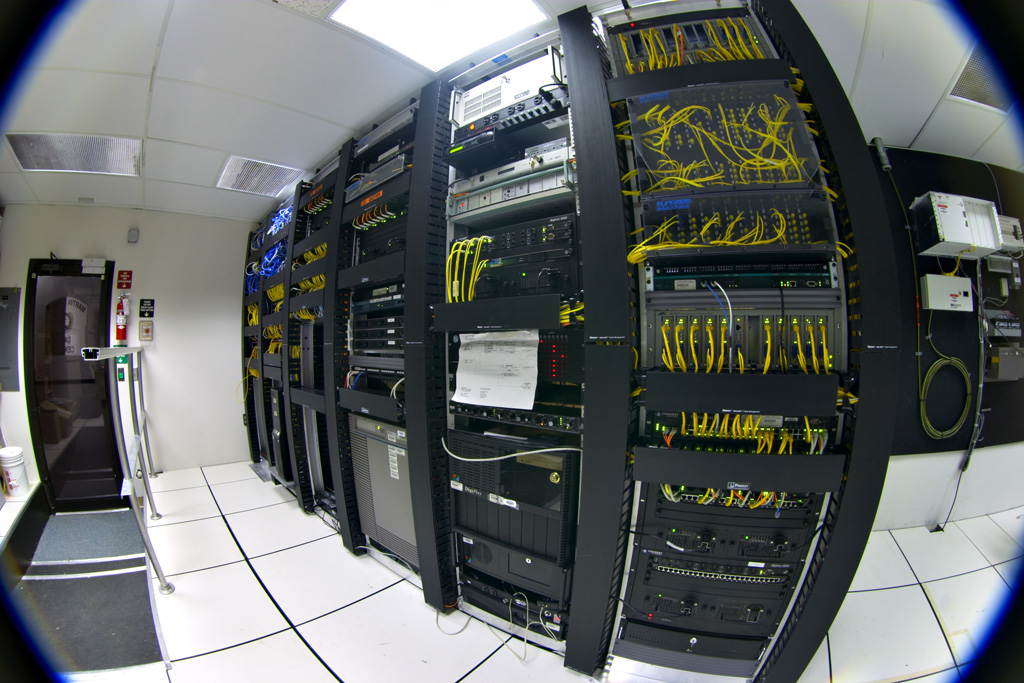
The real 2027 constraint isn't the GPU price, it's the megawatts to run racks like these. Photo: Wikimedia Commons (GFDL 1.2)
NVIDIA, executing its most compressed generational handoff with full pricing leverage. TSMC, monetizing $56B of CoWoS-L expansion. SK Hynix, carrying ~two-thirds of Rubin HBM4. And the eight first-wave hyperscalers who locked H2-2026 Rubin and the cost-per-token edge that comes with it.
Every buyer outside the allocation tier, structurally a secondary-market price-taker in 2027. Holders of GB300 collateral facing residual mark-downs once Rubin ships. And operators whose 2027 datacenter shells were sized for Blackwell-density power.
The startup opening. The opening is at the edges of the allocation system: GPU residual-value and refinance analytics timed to the Rubin handoff, power-interconnect brokerage and behind-the-meter generation for buyers stuck in 36-48 month grid queues, and allocation-intelligence services for the mid-market that will never sit in NVIDIA's first-wave room. The bottleneck moved from chips to megawatts, and that is a business.
1. The Next Platform: Vera Rubin NVL144 first-wave customers (Mar 2026) [6 min]
2. Tom's Hardware: Rubin NVL144 compute specs and pricing (Mar-Apr 2026) [5 min]
3. TrendForce: HBM4 qualification and supply share (Jan 2026) [5 min]
4. Axios: Jensen Huang $1T data-center revenue anchor, GTC 2026 [4 min]
GB300 / Blackwell Ultra: NVIDIA's current top AI rack. As of late 2026 it is a transitional asset, still useful but one generation from obsolescence.
Rubin / VR200: NVIDIA's next GPU platform, shipping H2 2026 with roughly 10x the FP4 throughput of GB300. The part worth waiting for.
FP4: a 4-bit number format for AI inference. More FP4 throughput means more tokens per second per dollar of hardware.
CoWoS-L: TSMC's advanced packaging that fuses GPU die and HBM. NVIDIA has locked ~60% of 2026 capacity for Rubin; it is the gating resource.
HBM4: the next high-bandwidth-memory generation, now ~25% of a Rubin system's cost. SK Hynix qualified first and carries about two-thirds.
EFLOPS: exaFLOPS, a billion-billion math operations per second. The unit the GB300-to-Rubin 10x jump is measured in.
Corrections & coffee: [email protected]
