
Nvidia has Intel's old job.
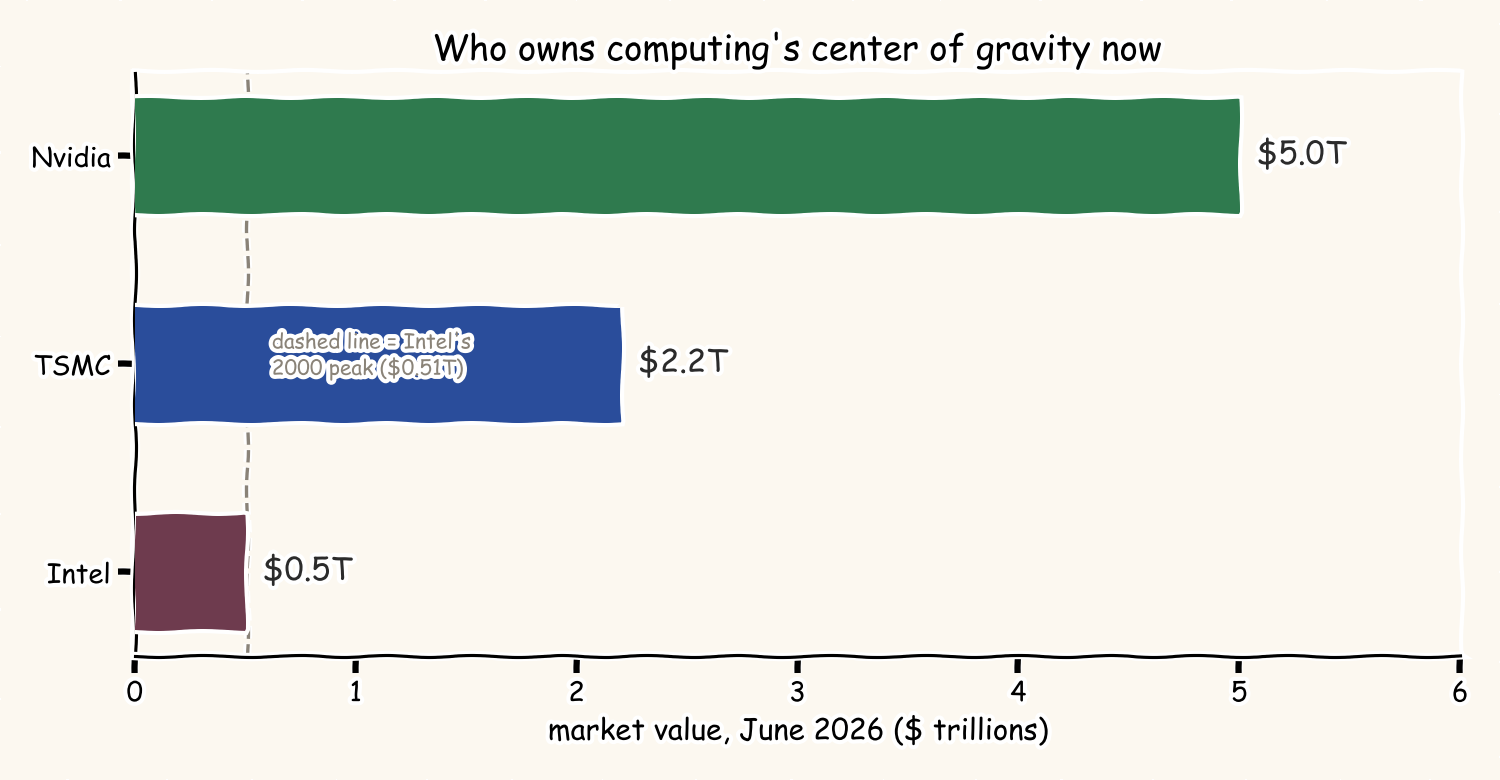
Nvidia is the most valuable company in the world because it sells the one thing the entire AI build-out cannot proceed without, and because a software layer, CUDA, makes switching away from it painful. In late 2025 it became the first company ever to cross $5 trillion; it briefly touched $5.5T this spring, and even after a sharp early-June pullback it sits near $5T, worth more than every public company on Earth and more than every national stock market except the United States. With record FY2026 revenue of $216B (about $194B of it data center) and roughly 80% of the AI-accelerator market, it is priced as if that position is permanent.
We have seen this exact movie before, and we know how the middle acts play out. From the 1980s through the 2000s, the company that owned computing's center of gravity was Intel. It owned the x86 instruction set, it stamped Intel Inside on the box, and it taxed nearly every PC on Earth. In August 2000 Intel was the most valuable public company in the world at $509 billion. The two stories rhyme so loudly that the lazy take almost writes itself, in either direction. This piece argues the lazy takes are both wrong.
The standard is the moat. The standard is also the trap.
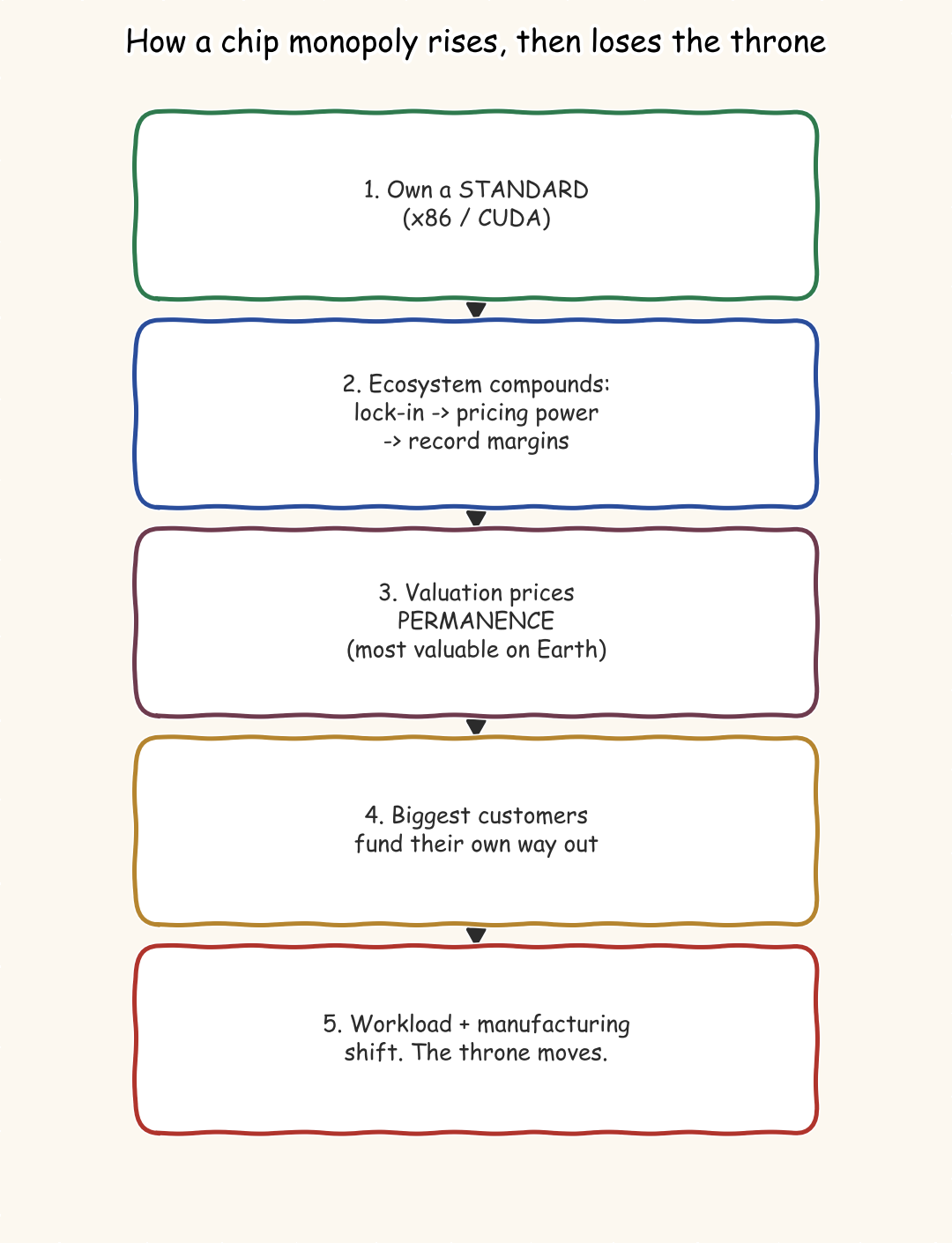
Before the parallels, the mechanism. Monopolies in semiconductors do not come from making the fastest chip for one year. They come from owning a standard, a piece of the stack that everyone else writes their software and builds their products against, so that leaving you means abandoning their own work. x86 was that standard for the PC. CUDA is that standard for AI. The pattern from there is almost mechanical, and it ends the same way every time.
The rhyme is real. So are the differences.
Four parallels do most of the work. One, the moat is a standard, not a chip: x86 and CUDA both win because the world's software is written against them, so the switching cost is other people's code. Two, the customer is also the rival: the PC makers that lived on Intel and the hyperscalers that live on Nvidia are the same firms with the most reason to build an alternative, and today's hyperscalers have far more cash and chip-design talent than any 1990s PC maker ever did. Three, the valuation prices permanence: Intel at $509B in 2000 and Nvidia near $5T in 2025-26 were each, at their peak, the most valuable company on Earth, priced as though the tax never ends. Four, a single manufacturing dependency sits underneath: Intel's was its own fabs; Nvidia's is TSMC and its CoWoS packaging, the exact bottleneck we covered in The CoWoS Ceiling.
| Dimension | Intel, then | Nvidia, now |
|---|---|---|
| The standard | x86 instruction set | CUDA software platform |
| Peak valuation | $509B (2000), No. 1 on Earth | ~$5T (2025-26), No. 1 on Earth |
| The moat | Tied to its own fabs | Pure software, travels across foundries |
| The model | IDM: designs AND builds | Fabless: designs, TSMC builds |
| The rival-customer | PC makers, Apple to ARM | Hyperscalers building TPU, Trainium, Maia |
| The market | Maturing by 2005 | Still early, still expanding |
Now the three differences, because they cut the other way and they matter. First, the business model. Intel was an IDM: it designed and manufactured. So when its fabs fell behind TSMC, the whole company fell with them, and you cannot re-staff a fab the way you re-staff a sales team. Nvidia is fabless and asset-light; a manufacturing stumble is TSMC's problem to solve, not a decade-long Intel-style retooling. Second, the kind of moat. x86 was bound to Intel's own process; CUDA is software that travels across foundries and nodes, which arguably makes it the stickier lock-in. Third, the market's maturity. The PC market Intel rode was sliding into a slow replacement cycle by 2005; AI compute is still early. The pie is growing faster than any single rival can take share, which is why Nvidia's revenue keeps climbing even as its share drifts from roughly 90% toward 80%.
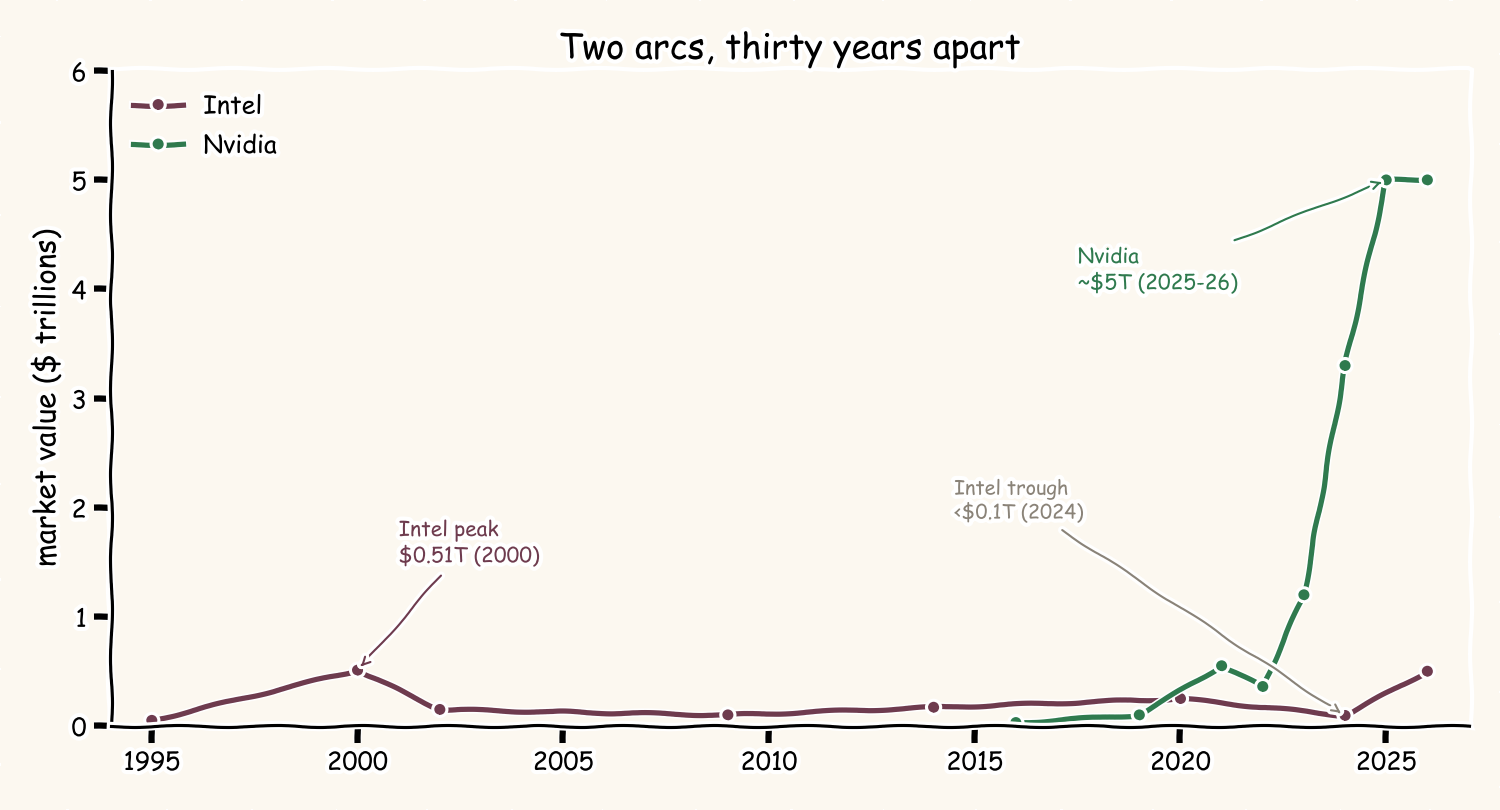
People use "bubble" to mean two different things, and Intel's history separates them cleanly. There is the market bubble, the moment a price detaches from any reasonable future, and there is the business plateau, the slower discovery that the monopoly was never as permanent as the price assumed. Intel had both, three years apart, and conflating them is how people misread Nvidia today.
The market bubble popped first, and it popped on a specific day. On September 21, 2000, Intel warned that revenue would miss, blaming a weak euro. The stock fell about a fifth in a session and erased on the order of $120 billion in a day, contagion ripping through the whole chip complex. Ten years of "priced for permanence" met one press release. Crucially, Intel the business was still dominant for years afterward; what broke in 2000 was the price, not the company. The plateau, missing mobile, losing the process lead to TSMC, came later and slower.
For Nvidia, the analog is the AI-capex question. The valuation assumes hyperscaler AI spending compounds for years and that Nvidia keeps almost all of it. The early-June 2026 pullback that knocked it briefly under $5T is a reminder that the price can correct hard while the business stays dominant, exactly the Intel-2000 pattern. The honest distinction: a price correction is a Tuesday; the platform shift is the decade. Watch which one you are actually looking at.
The most useful and least-told part of the Intel story is not the missed iPhone. It is that Intel spent decades unsure of its own core competency, and the one time it answered the question correctly, it saved the company. In 1985, crushed by Japanese memory makers, Andy Grove famously asked Gordon Moore what a new CEO would do, then walked back in and did it himself: Intel exited DRAM, the business it was founded on, and bet everything on microprocessors. That clarity, "we are a logic company, not a memory company", built the monopoly.
Intel then spent the next thirty years slowly losing that clarity. Was it a chip designer or a manufacturer? An IDM whose edge was owning both, or a products company trapped by failing fabs? It tried to be everything, delayed the hard call, and let TSMC, a company that did exactly one thing, make chips for everyone else, take the manufacturing crown. The irony of 2026 is that Intel has finally answered the question again: it is leaning hard into foundry, and it just won a marquee AI-chip manufacturing order from Google and is in talks to make chips for Apple, the very company whose defection symbolized its decline. That is why the stock has roughly quadrupled off its 2024 lows.
The lesson transfers directly to Nvidia, and it is sharper than the usual "don't get complacent." Nvidia's core competency is not the GPU; it is CUDA and the developer ecosystem around it. The day it starts defending the chip instead of the ecosystem, optimizing for this quarter's margin instead of the next decade's lock-in, is the day it starts becoming Intel, regardless of the share price.
Losing share and growing anyway.
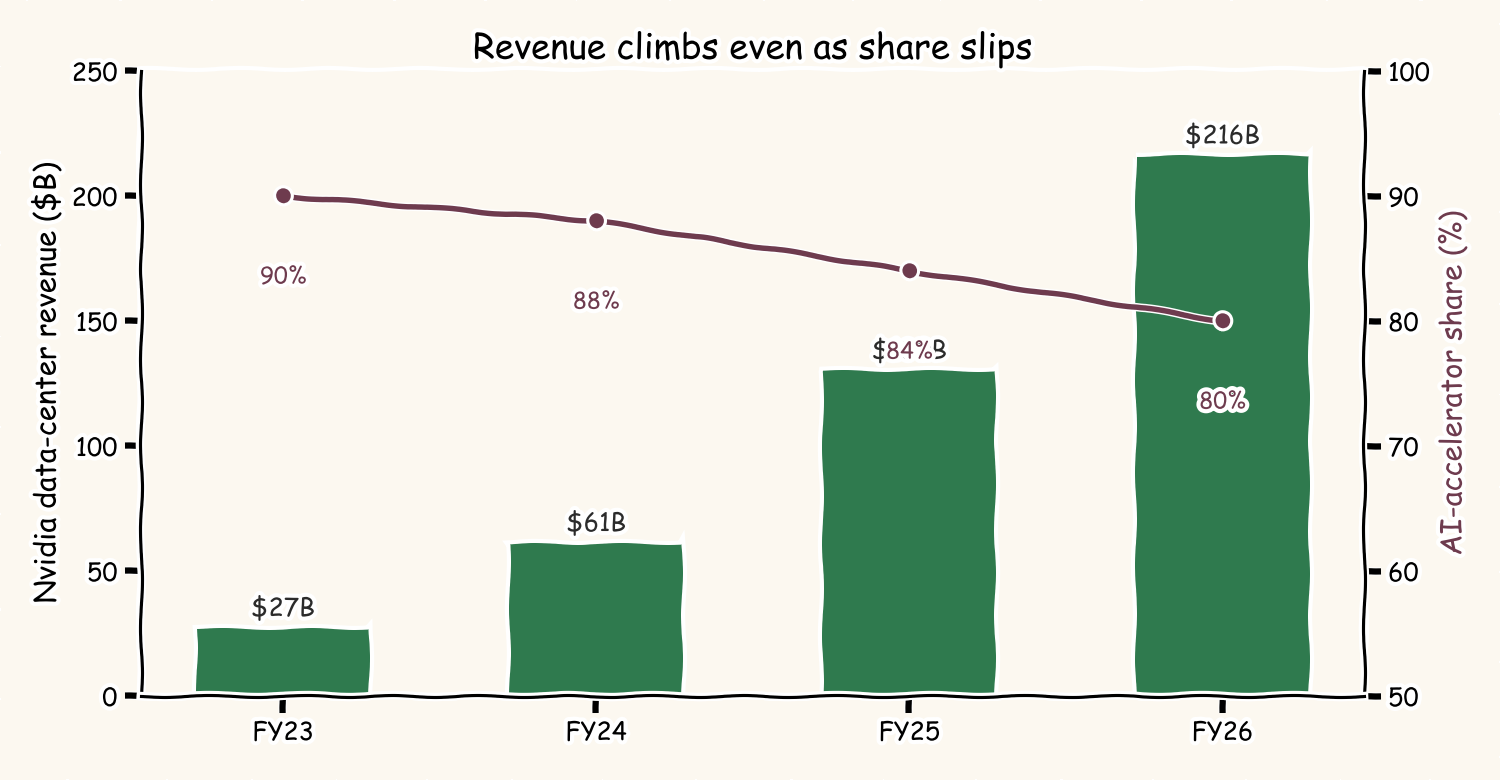
If you remember a single chart from this piece, make it the next one. The thing that makes Nvidia genuinely different from Intel-at-the-top is that its market is still growing faster than it is losing share. Nvidia's slice of AI accelerators has slipped from about 90% to about 80% as AMD and the hyperscalers' custom chips scale, and yet its data-center revenue has gone from $27B to $216B across the same window. Intel, by 2005, was defending a flat pie; Nvidia is bleeding share into a flood. Both can be true: the monopoly is eroding at the margin and the absolute business is still compounding. That is the tension every Nvidia model has to hold in its head at once.
TSMC, above all. The quiet lesson of this whole story is that the company that won the last thirty years was not the one that owned the standard, it was the one that learned to manufacture for everyone. At ~$2.2T, TSMC is now worth more than four Intels and makes the chips for Nvidia, Apple, AMD and, increasingly, Intel's customers too. Nvidia itself, on a still-growing pie and the deepest ecosystem in computing. And the hyperscalers fielding credible in-house silicon.
Anyone underwriting Nvidia's ~$5T as a permanent monopoly rather than a dominant position on a contested, fast-growing market. Single-source AI buyers with no portability plan, the modern version of a 2005 PC maker who assumed x86 forever. And, still, Intel, recovering impressively but not yet back at the center it once defined.
The startup opening. It is in portability and the picks-and-shovels of a multi-accelerator world: compiler and abstraction layers that make models vendor- and foundry-agnostic, inference-optimization tools for custom silicon, and the qualification services buyers need to run a credible second source. Every monopoly funds the market for its own alternative; the CUDA era will be no different.
The GTM bets that shouldn't have worked, and did

One grew revenue 50x after half his team quit over the strategy. One brought in 50K signups in a single day with no paid budget. One generated 100M+ views from a stunt that took 50 hours to conceive. One asked every prospect to demo the product themselves instead of demoing it for them.
None of them followed the safe playbook. They treated GTM like an experiment, moved before they had proof, and made bets most founders would never get approved.
HubSpot for Startups documented all 6 stories in the free Bold Bets Playbook. The risks they took, why it was risky, and what it returned.
| Phase | Intel | Nvidia |
|---|---|---|
| Founding | 1968, exits DRAM for logic in 1985 | 1993, ships CUDA in 2006 |
| The standard wins | x86 + IBM PC, Intel Inside | CUDA + the deep-learning boom |
| Coronation | Most valuable firm on Earth, 2000 | First to $5T, 2025 |
| The price breaks | Sept 2000: ~$120B wiped in a day | June 2026: briefly back under $5T |
| The slow test | Missed mobile; lost fabs to TSMC | Hyperscaler custom silicon; inference shift |
| Where it stands | ~$0.5T, foundry-led rebound | ~$5T, still the standard |
1. Nvidia FY2026 results: record $216B revenue, ~$194B data center [8 min]
2. Washington Post archive: 'Intel Shares Plunge on Earnings Forecast' (Sept 22, 2000) [5 min]
3. Barron's 'Burning Up' (Mar 20, 2000), the call that marked the dot-com top [6 min]
4. TSMC passes $2 trillion: Taipei Times market-cap coverage [4 min]
5. Clayton Christensen, 'The Innovator's Dilemma': why incumbents miss the next platform [12 min]
x86: Intel's processor instruction set, the standard the PC era was built on. Owning it let Intel tax nearly every PC for decades.
CUDA: Nvidia's software platform for programming its GPUs. The real moat: the world's AI code is written against it, so switching means rewriting.
IDM: integrated device manufacturer: designs AND fabricates its own chips (Intel). When its fabs fell behind TSMC, the whole company did.
Fabless: designs chips but outsources manufacturing (Nvidia, to TSMC). Asset-light, but dependent on the foundry it does not own.
Foundry: a company that manufactures chips for others (TSMC, and now Intel Foundry). The role that quietly won the last thirty years.
Custom ASIC: a chip a customer designs for its own workload (Google TPU, Amazon Trainium). The hyperscalers' route around Nvidia.
Platform shift: when the dominant workload moves (PC, to mobile, to AI). Incumbents that own the old platform usually miss the new one.
▸ Barron's, “Burning Up,” March 20, 2000, ran ten days after the Nasdaq peak and warned the dot-coms were running out of cash. It aged like wine. (reference)
▸ The Washington Post, September 22, 2000: “Intel Shares Plunge on Earnings Forecast.” One press release erased roughly $120 billion in a day, from the most valuable company on the planet. (read it)
So here is my suggestion: screenshot a “Nvidia hits $5 trillion” headline today and file it somewhere safe. Either it becomes the artifact your kids laugh at, or it becomes proof you were watching history. Both are worth keeping.
Corrections & coffee: [email protected]
Heavy Machinery Hasn't Changed in 100 Years. Until Now.

Every bulldozer, crane, and military vehicle on earth still runs on hydraulic fluid invented before your grandparents were born. RISE Robotics is the company finally replacing it with a patented electric system already trusted by the U.S. Air Force.
