

In partnership with

Write docs 4x faster. Without hating every second.

Nobody became a developer to write documentation. But the docs still need to get written — PRDs, README updates, architecture decisions, onboarding guides.
Wispr Flow lets you talk through it instead. Speak naturally about what the code does, how it works, and why you built it that way. Flow formats everything into clean, professional text you can paste into Notion, Confluence, or GitHub.
Used by engineering teams at OpenAI, Vercel, and Clay. 89% of messages sent with zero edits. Works system-wide on Mac, Windows, and iPhone.
China flooded the unglamorous node.
While the industry argued about 2nm yields and CoWoS allocation, China built the decade's most consequential supply-chain disruption at the other end of the spectrum, with 28nm lithography, subsidies, and the conviction that the $200B+ mature-node market was worth owning regardless of near-term returns. Between 2022 and 2026, SMIC, Hua Hong, Nexchip and newer entrants added an estimated 1.2-1.5 million 200mm-equivalent wafer starts per month at 28/40/55nm, a 17-21% net increase to a global segment that was already well-supplied.
This expansion isn't market-driven. Chinese mature-node fabs ran below 60% utilization through much of 2024 even as capacity kept coming, because Big Fund III (~$41B committed in 2024) and provincial co-investment decoupled fab economics from the cost signals that would halt any private buildout. The downstream effect is already in earnings calls: 28nm MCU pricing down 20-30% in 18 months, PMICs down 15-25%, display drivers down 20-30%. These aren't peripheral parts, they are the connective tissue of every car, appliance and machine made today.

A microcontroller die. The $0.40 MCU is exactly the part China's mature-node flood is repricing. Photo: Ioan Sameli / Wikimedia Commons (CC BY-SA 2.0)
SMIC, Hua Hong, Nexchip (China) the foundries adding mature-node capacity at scale.
Big Fund III & provinces the ~$41B of state capital that decoupled fab economics from cost signals.
Western IDMs (TI, STMicro, Renesas, Infineon, NXP) the incumbents whose commodity lines compress.
TSMC, GlobalFoundries, Samsung holding surplus 28nm capacity buyers can negotiate against.
Auto Tier-2/3 and OEMs (BYD, SAIC, Geely) designing the cheap MCUs into vehicle platforms.
1. State subsidies fund mature-node fab capacity regardless of near-term returns.
2. Fabs add 28/40/55nm wafer starts and run them below cost at sub-60% utilization.
3. Component ASPs (MCU, PMIC, display driver) compress 15-30% across 18 months.
4. Tier-2/3 assemblers design the cheap parts into body control, power and lighting.
5. They land in cars, appliances and factory gear over a 3-5 year design cycle, displacing incumbents.
Neutral process view. The buildout's subsidy basis is stated as reported; no political position taken.
The correction arrives on a government budget timeline.
There are two companies in this story, buyers and sellers of mature-node components, and the right move is opposite for each. If you buy MCUs, PMICs or display drivers in volume, your cost structure is improving while your supply chain bifurcates; the move is to lock the decline into contract now. If you make them, the commodity segments are in permanent structural compression, not a cyclical dip, and the survivors are climbing the value stack toward AEC-Q100 automotive, ISO 13485 medical and export-controlled defense parts, where qualification cycles and export controls build moats subsidized fabs can't cross on policy timelines.
The automotive exposure is the least discussed and most significant. A modern ICE car carries 40-60 MCUs; a premium BEV, 60-100, rising toward 150. So this isn't only an MCU price event, it's a design-win displacement event compounding over the 3-5 year automotive design cycle. And because the expansion is subsidy-driven, the correction arrives on a government budget timeline, not a commercial one: the ASP floor forms when Chinese utilization reaches the point where subsidies stop covering operating losses, not when the market signals overcapacity. Big Fund III disbursement pace, not spot prices, is the leading indicator.
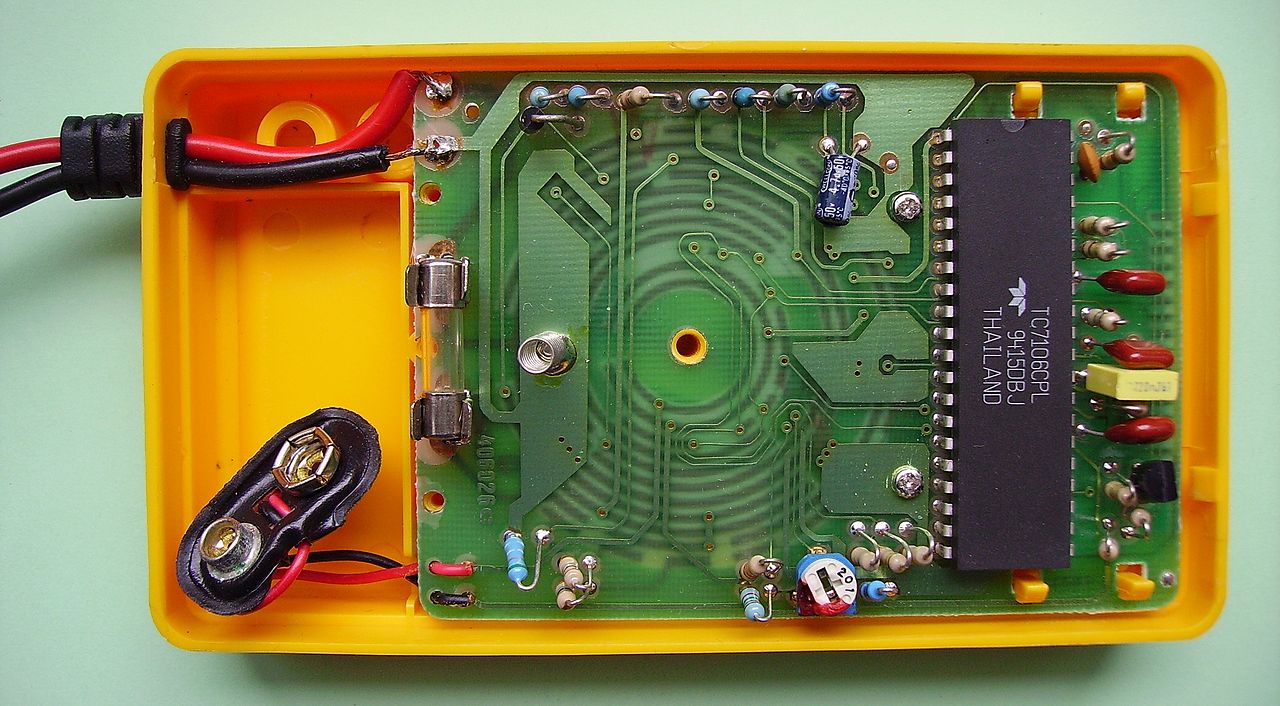
The MCUs, PMICs and display drivers on a board like this are the connective tissue of every car and appliance. Photo: Cjp24 / Wikimedia Commons (CC BY-SA 3.0)
Volume buyers of mature-node parts, automakers, industrials, appliance and electronics makers, whose cost structure is improving. The Chinese foundries taking share. And the incumbents that move decisively up the value stack into qualification- and export-gated parts.
Western commodity-MCU/PMIC makers, TI most exposed, facing structural, not cyclical, margin compression. Any buyer single-sourced on a subsidized Chinese fab if utilization stays low and corners get cut. And mid-tier automotive sockets vulnerable to design-win displacement.
The startup opening. The opening is in seeing the exposure and pricing the floor: MCU-level supply-chain audit tooling that maps Tier-2/3 Chinese-origin content before a PPAP, dual-qualification acceleration services with pre-defined quality holds, and ASP-floor intelligence that tracks Big Fund III disbursement rather than spot prices. The data is not going to get more comfortable, and that is the market.
1. SEMI: global mature-node capacity tracker (2025) [5 min]
2. TrendForce: China fab utilization, Q4 2024 / Q1 2026 [5 min]
3. Omdia: mature-node ASP database (2026) [6 min]
4. MIIT: Big Fund III disclosure (2024) [4 min]
Mature node: older, larger chip geometries (28nm and above) used in cars, appliances and industrial gear. Not cutting-edge, but everywhere.
MCU: microcontroller, the small brain that runs a discrete function. A modern car carries 40-150 of them.
PMIC: power management IC, the chip that regulates voltage and power delivery in nearly every electronic device.
Wafer starts: how much a fab actually runs per month. China added 1.2-1.5M wafer starts of mature-node capacity, 17-21% of the global baseline.
Big Fund III: China's ~$41B national IC investment fund, the state capital that lets fabs run below cost without halting.
AEC-Q100: the automotive chip qualification standard. Its long cycle is a moat that subsidized commodity fabs can't quickly cross.
Corrections & coffee: [email protected]
100+ Claude Code hacks to ship code 10X faster

Top engineers at Anthropic say AI now writes 100% of their code.
Are you using AI to write yours?
These 100+ Claude Code hacks show you exactly how. Sign up for The Code and get:
100+ Claude Code hacks — free
The Code newsletter — learn the latest AI tools and skills to code faster in 5 mins a day
