

A family friend called me last month, annoyed. A company had bought the empty plot behind his house, the one where kids used to play cricket, and put up what he described as a big grey shed with no windows, and then its own little electrical substation right next to it. He asked me, half-joking, why a warehouse would need more power than his entire lane.
It is not a warehouse. It is a data center, and it really will pull more electricity than his whole street. The leap from a normal building to an AI building breaks the intuition of people who have wired houses their entire lives. That leap is what this part is about.
What's inside
In Part 1 we followed a single AI chip from a quartz mine in North Carolina to the moment it arrives at a data center, already carrying an invisible backpack of electricity and clean water spent before it ever switches on. Now we walk into the room where it goes to work. It is louder, hotter, and hungrier than almost anyone picturing "the cloud" imagines.
Here is the sentence to hold onto: one modern AI rack now draws more power than an entire residential street, and a single building can hold thousands of them.
1. Start with the rack, because that is the new unit of AI
For twenty years, the basic building block of a data center was a server rack that pulled somewhere between 3 and 8 kilowatts. That was the norm. The global average rack density still sits around 8 kW today (Sunbird DCIM, 2025). Picture a tall metal cabinet of pizza-box servers, warm to the touch, cooled by cold air blown up through the floor.
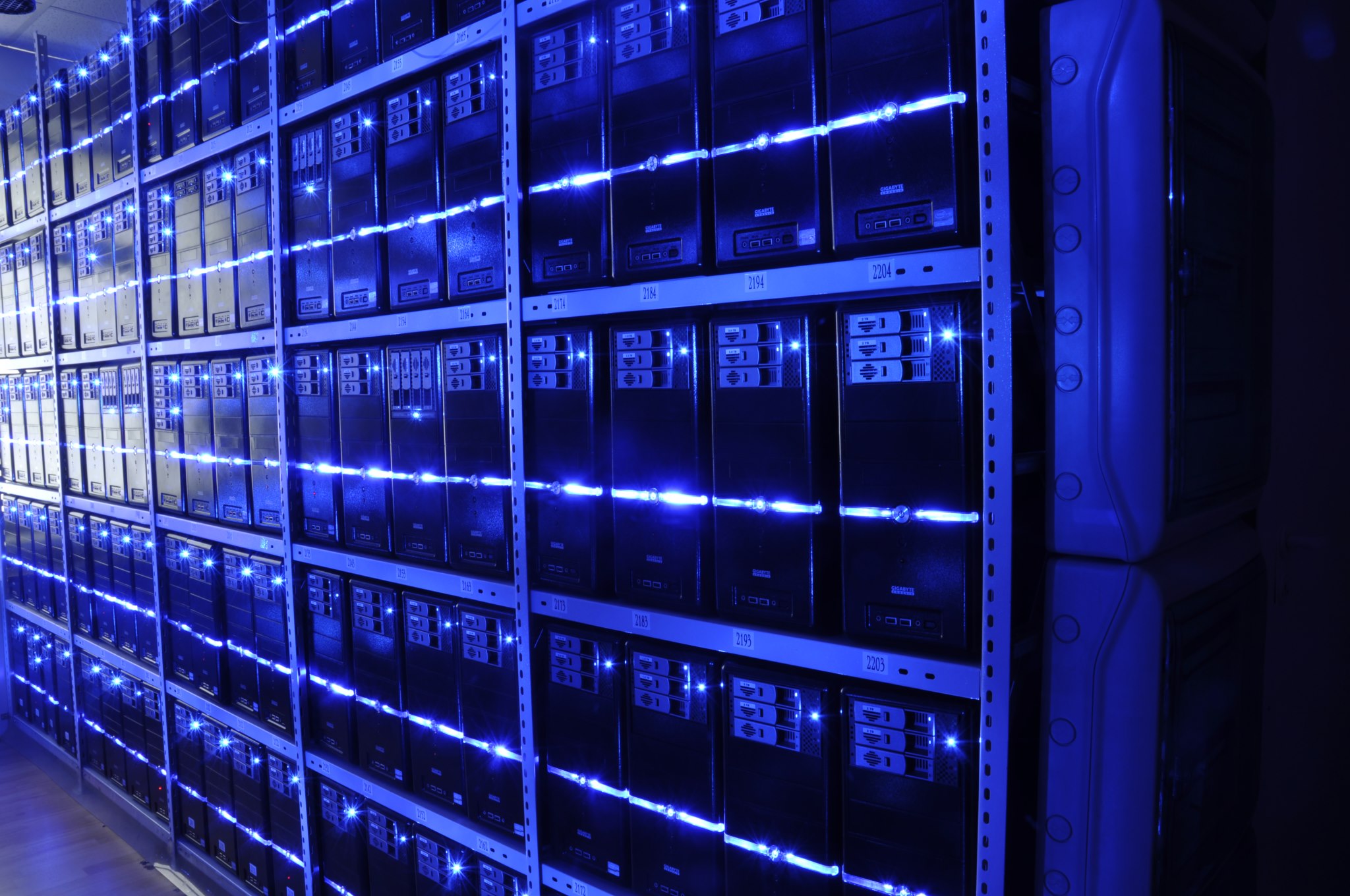
The room where AI runs: rows of racks, each one now a small power plant of its own. Photo: BalticServers.com (CC BY-SA 3.0).
The AI rack broke that mold. NVIDIA's GB200 NVL72 packs 72 Blackwell GPUs and 36 Grace CPUs into one cabinet and draws about 120 kW at full load (The Register; NVIDIA, 2024). Its 2025 successor, the GB300 NVL72, runs harder still: 132 to 140 kW under normal load, with peaks reported near 155 kW (Sunbird DCIM; Introl, 2025). That is roughly 17 times a normal rack, in the same floor space.
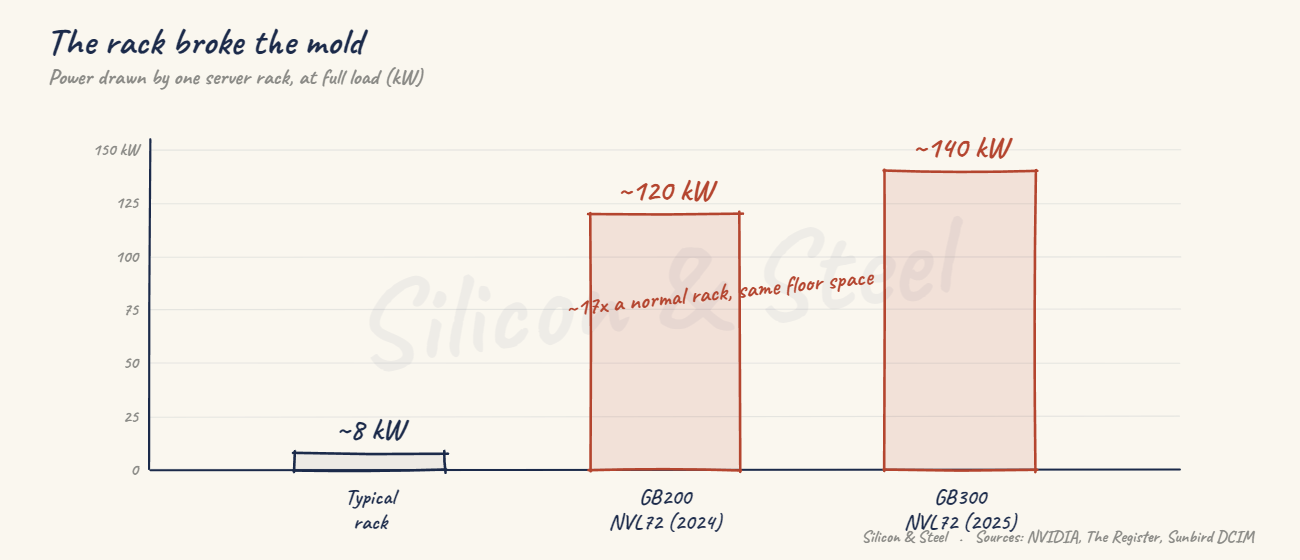
A normal rack held steady near 8 kW for years. The AI rack broke the mold, pulling roughly 17 times that in the same floor space.
Think of it this way. The old rack was a family home's worth of power. The new rack is a small apartment block, stacked into one cabinet that weighs about 1.36 metric tons, the weight of a small car (NVIDIA, 2024).
2. Why air stopped working, and water moved in
You cannot blow enough cold air across a 140 kW cabinet to keep it alive. The heat is too concentrated. So the industry did what power plants and car engines did a century ago: it switched to liquid.
Modern AI racks are "direct-to-chip" liquid cooled. Coolant runs through cold plates pressed right onto the hottest chips, carrying the heat out as a warm liquid instead of a blast of hot air. The GB300 rack alone throws off about 409,000 BTU per hour of heat (Sunbird DCIM, 2025), enough to heat several homes in winter. That heat has to go somewhere, every second, forever, or the chips cook.
This is the quiet turning point of the AI build-out. We did not just make chips hungrier. We changed the plumbing of the entire building.
3. Now zoom out: the rack is not the bill, the building is
Here is the part most coverage skips. The power a rack draws is not the power the data center draws. Every watt that reaches a chip drags extra watts behind it, for cooling, for power conversion losses, for lights and air handling. The industry measures this with a number called PUE, Power Usage Effectiveness.
PUE is simple: total building power divided by the power that actually reaches the computers. A PUE of 1.0 would be perfect, every watt going to compute. Older data centers ran at 2.0, meaning they burned a full watt of overhead for every watt of real work. The best modern hyperscale campuses now run near 1.1 to 1.2 (Microsoft, 2025). So for every 100 megawatts of chips, the building actually pulls 110 to 120 megawatts from the grid.
4. The Interesting Numbers
Here is the number that shows how fast this snuck up on the grid. In 2023, all US data centers together used about 176 terawatt-hours of electricity, roughly 4.4% of the country's power. By 2024 that was 192 terawatt-hours, about 4.7% (Lawrence Berkeley National Laboratory, Jan 2025). The same lab projects it climbing to somewhere between 325 and 580 terawatt-hours by 2028, which would be 6.7% to 12% of all US electricity.
Read that again. A single industry could go from one twenty-fifth of the nation's power to as much as one eighth, in five years. That is not a trend. That is a step change, and the grid was not built for step changes.
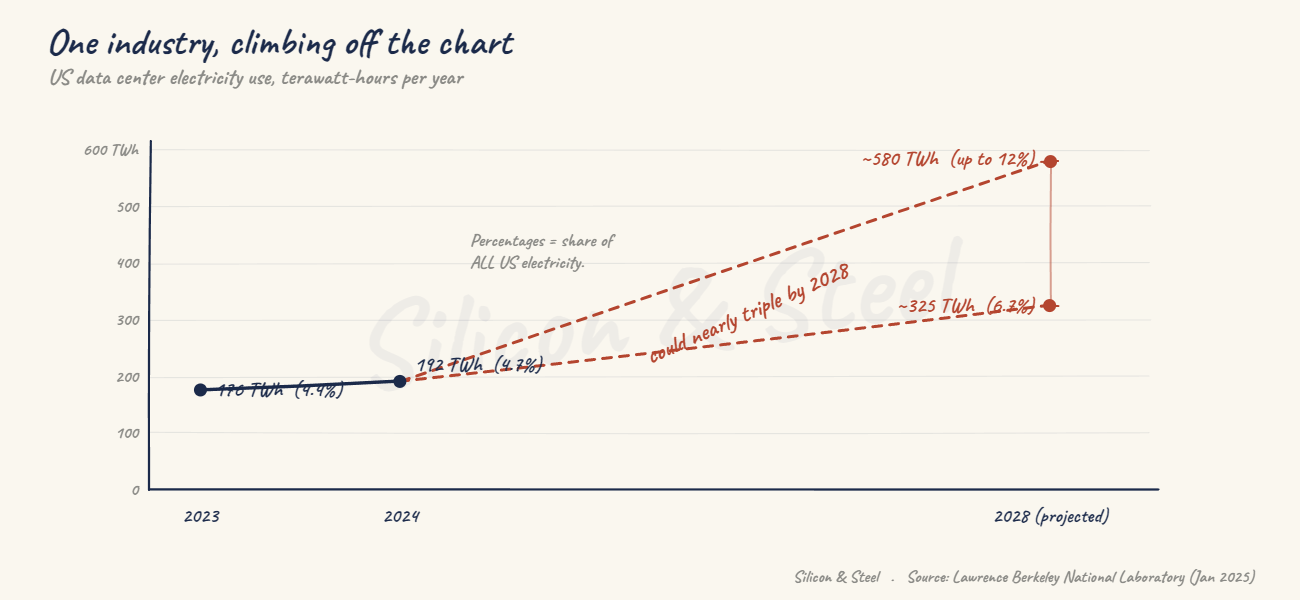
Data centers could go from one twenty-fifth to as much as one eighth of all US electricity in five years. Source: Lawrence Berkeley National Laboratory, Jan 2025.
5. What a gigawatt actually means
The new AI campuses are not measured in racks anymore. They are measured in gigawatts, the language of power plants. OpenAI's Stargate project is targeting up to 10 gigawatts of compute capacity, backed by a roughly $500 billion commitment (OpenAI, 2025). xAI's Colossus cluster in Memphis stood up 100,000 GPUs in 122 days, and its second phase aims past 1 gigawatt and a million GPUs (Data Center Frontier; xAI, 2025).
One gigawatt is enough to power roughly 700,000 homes. So a single AI campus can now draw what a mid-sized American city draws, and the companies building them want several. This is why you are suddenly reading about tech firms signing deals for nuclear plants and gas turbines. The chips outran the grid, so the grid has to be rebuilt around them.
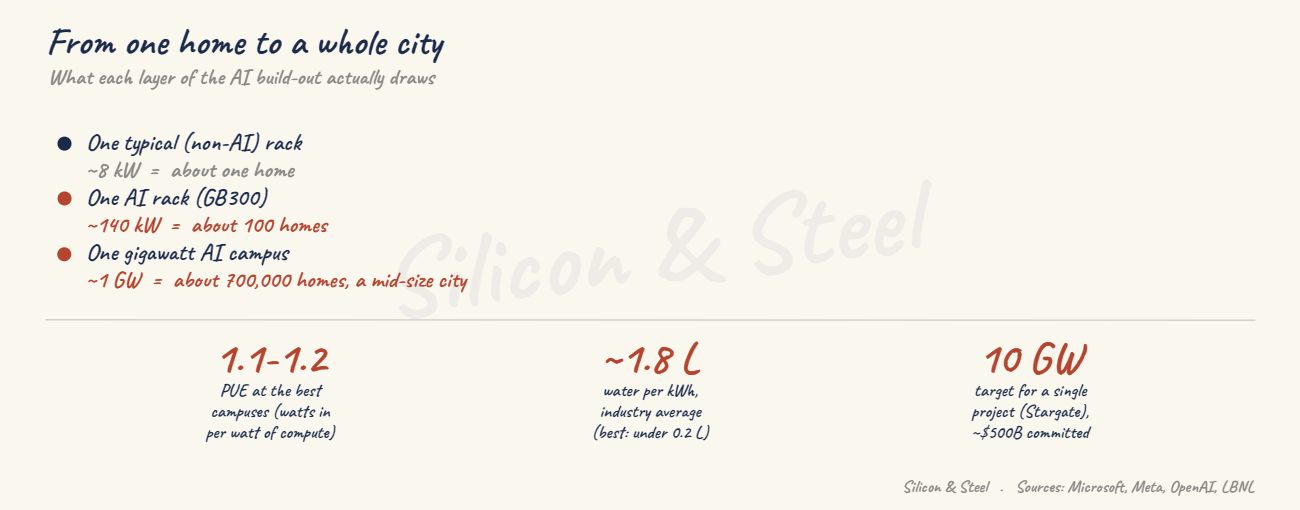
One AI rack equals about 100 homes. One gigawatt campus equals a mid-size city, and the biggest projects want ten of those.
6. Do not forget the water, again
The chip was thirsty to make. The building is thirsty to run. Many data centers still cool with evaporation, essentially a giant version of sweating, which uses water to shed heat. The industry measures this with WUE, Water Usage Effectiveness, in liters of water per kilowatt-hour of computing.
The spread is enormous. Meta has cited an industry average near 1.8 liters per kWh (Meta, 2025). The best operators do far better: Amazon reports 0.19 and Meta's newest buildings 0.20, while Microsoft's Arizona site runs at 1.52 and its Singapore site at just 0.02 (Microsoft; company reports, 2025). Closed-loop liquid cooling, the kind the densest AI racks use, can push on-site water use close to zero, but often by pushing the heat, and the water, somewhere else. There is no free lunch. There is only where you decide to pay.
7. Who's who along the chain (Part 2)
The rack builders (NVIDIA's reference designs, assembled by Supermicro, Dell, Lenovo, Foxconn) who turn loose chips into a 140 kW cabinet.
The cooling makers (Vertiv, Schneider Electric, and a wave of liquid-cooling specialists) who keep the cabinet from melting.
The power providers (utilities, independent power producers, and now nuclear and gas developers) racing to feed gigawatt campuses.
The local watershed and grid operator who quietly set the real speed limit on all of it.
8. Where we go next
The chip was expensive to make. The rack is expensive to run, in watts and water, at a scale the grid is scrambling to match. This was Part 2: The Rack. In Part 3: The Token we finally do the math you actually care about: when you ask an AI a question, what does that single answer cost, down to the fraction of a cent, the watt-hours, and the drops of water?
Related from Silicon & Steel:
9. Assumptions and hypotheses (stated plainly)
Rack power figures are nameplate and typical-load estimates, not audited per-site measurements. Real draw varies with workload; GB300 numbers range from about 120 kW nameplate to 155 kW peak across sources.
PUE and WUE vary enormously by operator, climate, and cooling design. The 1.1 to 1.2 PUE and sub-0.2 WUE figures are best-in-class, not industry-wide averages.
The LBNL 2028 range (325 to 580 TWh) is a projection, not a certainty, and depends heavily on how fast AI demand and efficiency both move.
Gigawatt campus figures (Stargate, Colossus) are announced targets, some still under construction, and headline capacity is not the same as power drawn today.
"1 GW powers ~700,000 homes" is a rounded rule of thumb; actual homes-per-GW depends on region and season.
One last thing.
This space moves fast, faster than any one person can fully keep up with, me included. I'm learning right alongside you. I just try to stay a step out on the edge so you don't have to. If I ever get something wrong, tell me: email me anytime at [email protected], and if you're up for it, let's grab a coffee. That's an open invite to everyone reading, free or paid.
Talk soon,
Silicon & Steel Intelligence Desk · AI Infrastructure — written with Gaurav Singh Chaudhary.
Brief errors or update intelligence: [email protected]
